-
Using slopes, prove that the \(A = (2, 1)\), \(B = (-4, -2)\) and \(C = (1, 1/2)\) are collinear.
In exercises 2 through 9, find an equation of the line that satisfies the given conditions and express it in the form \(\boldsymbol{y = mx + b}\).
-
Passes through (1, 3); has slope 5.
-
Passes through the origin; has slope 5.
-
Passes through (1, 1) and (2, 3).
-
x-Intercept 5; y-Intercept 2
-
Passes through (1, 3), and is parallel to the line \(5y + 3x – 6 = 0\).
-
Passes through (4, 3), and is perpendicular to the line \(5x + y – 2 = 0\).
-
Is parallel to \(2y + 4x – 5 = 0\), and passes through the intersection of the lines:
\[
5x + y = 4 \quad \text{ and } \quad 2x + 5y – 3 = 0
\]
-
Passes through (8,-6), and intersects the axes at equal distances from the origin.
-
Given the line \(L:\, 2y – 4x – 7 = 0\) find:
-
the line passing through \(P = (1, 1)\), and perpendicular to \(L\).
-
the distance from the point \(P = (1, 1)\) to \(L\).
-
Using slopes, prove that the points \(A = (3, 1)\), \(B = (6, 0)\) and \(C = (4, 4)\) are the vertices of a right triangle. Find the area of the triangle.
-
Determine which lines are parallel and which are perpendicular:
-
\[
L_1:\, 2x + 5y – 6 = 0
\]
-
\[
L_2: \, 4x + 3y – 6 = 0
\]
-
\[
L_3: \, -5x + 2y – 8 = 0
\]
-
\[
L_4: \, 5x + y – 3 = 0
\]
-
\[
L_5: \, 4x + 3y – 9 = 0
\]
-
\[
L_6: \, -x + 5y – 20 = 0
\]
-
Find the perpendicular bisector of the segment joining the given points:
-
\[
(1, \, 0) \, \text{ and } \, (2, \, -3)
\]
-
\[
(-1, \, 2) \, \text{ and } \, (3, \, 10)
\]
-
\[
(-2, \, 3) \, \text{ and } \,(-2, \, -1)
\]
-
The endpoints of one of the diagonals of a rhombus are \((2, -1)\) and \((14, 3)\). Find an equation of the line that coincides with the other diagonal.
Hint: the diagonals of a rhombus are perpendicular
-
Find the distance from the origin to the line \(4x + 3y -15 = 0\).
-
Find the distance from the point (0,-3) to the line \(5x – 12y – 10 = 0\).
-
Find the distance from the point (1,-2) to the line \(x – 3y = 5\).
-
Find the distance between the parallel lines\(3x – 4y = 0\) and \(3x – 4y = 10\).
-
Find the distance between the parallel lines \(3x – y + 1 = 0\) and \(3x – y + 9 = 0\).
-
Find the distance from the point \(Q = (6, -3)\) to the line passing through \(P = (-4, 1)\) and parallel to the line \(4x + 3y = 0\).
-
Determine the value of \(C\) in the equation of the line \(L\): \(4x +3y + C = 0\). It is known that the distance from the point \(Q = (5, 9)\) to the line \(L\) is 4 times the distance from the point \(P = (-3, 3)\) to the line \(L\).
-
Find the lines parallel to the line \(5x + 12y – 12 = 0\) that are 4 units away from this line.
-
Find the equation of the tangent line to the circle \(x^2 + y^2 – 4x + 6y – 12 = 0\) at the point (-1, 1).
-
Find the equations of the two lines passing through the point \(P = (2, -8)\), and are also tangent to the circle \(x^2 + y^2 = 34\).
-
In the above exercise, find the points where the tangent lines make contact with the circle.
-
Find the equation of each of the two lines parallel to the line \(2x – 2y + 5 = 0\), which are also tangent to the circle \(x^2 + y^2 = 9\).
-
Find the equation of the tangent line to the circle \(x^2 + y^2 + 2x + 4y – 20 = 0\) at the point (2, 2).
-
Find the equation of the circle with center \(C = (1, -1)\), and is also tangent to the line \(5x – 12y + 22 = 0\).
-
Find the equation of the circle passing through the point $Q = (4, 0)$,
and is also tangent to the line \(3x – 4y + 20 = 0\) at the point \(P = (-12/5, \,16/5)\).
-
Find the equation of the circle passing through the points (3, 1) and (-1, 3), with center in the line \(3x – y – 2 = 0\).
-
Both parallel lines, \(2x + y -5 = 0\) and \(2x + y +15 = 0\), are tangent to a circle. One point of tangency is \(B = (2, 1)\). Find an equation of the circle.
-
Find an equation of the line passing through the point \(P = (8, 6)\), which also forms a triangle of area 12 with the coordinate axes.
-
Determine the values of \(k\) and \(n\) in the equations of the lines:
\[
L_1:kx – 2y – 3 = 0 \quad \text{and} \quad L_2:6x – 4y – n = 0,
\]
\[
\begin{aligned}
&L_1: kx – 2y – 3 = 0 \text{ and}
\\[1em]
&L_2: 6x – 4y – n = 0,
\end{aligned}
\]
-
if \(L_1\) intersects \(L_2\) in a single point.
-
if \(L_1\) and \(L_2\) are perpendicular.
-
if \(L_1\) and \(L_2\) are parallel and not coincident.
-
if \(L_1\) and \(L_2\) are coincident.
-
Determine for what values of \(k\) and \(n\) the lines:
\[
kx + 8y + n = 0
\quad
\text{ and }
\quad
2x + ky – 1 = 0,
\]
\[
\begin{aligned}
&kx + 8y + n = 0
\text{ and}
\\[1em]
&2x + ky – 1 = 0,
\end{aligned}
\]
-
are parallel and not coincident.
-
are coincident.
-
are perpendicular.
-
The center of a square is \(C = (1, -1)\), and one of its sides is on the line \(x-2y = -12\). Find the equations of the lines containing the other sides.
-
Prove that the points \(A = (1, 4)\), \(B = (5, 1)\), \(C = (8, 5)\) and \(C = (8, 5)\) are the vertices of a rhombus (a quadrilateral whose sides have equal length). Verify that the diagonals are perpendicular.
-
Let \(a\) and \(b\) be the x-intersection and the y-intersection of a line. If \(a \neq 0\) and \(b \neq 0\), prove that an equation for this line is: \(\frac{x}{a} + \frac{y}{b} = 1\).
-
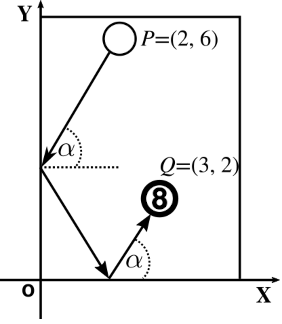
Roberto is playing pool in a championship.
He must hit, without spin, the eight ball with the white ball using two cushions of the table, as shown in the figure.
If the white ball is on the point \(P = (2, 6)\), and the red ball on \(Q = (3, 2)\), find the points \(A\) and \(B\) of the cushions of the table where the ball must hit to be successful.
If the white ball is on the point \(P = (2, 6)\), and the red ball on \(Q = (3, 2)\), find the points \(A\) and \(B\) of the cushions of the table where the ball must hit to be successful.