In the exercises 1 through 12, find the standard equation of the ellipse satisfying the given conditions.
-
Foci: \((\pm 2, 0)\). Vertices: \((\pm 6, 0)\).
-
Foci: \((0, \pm 5)\). Vertices: \((0, \pm 8)\).
-
Focus: (5, 2). Vertices: (2, 2), (6, 2).
-
Focus: (-4, 0). Vertices: (-4, -2), (-4, 8).
-
Vertices: (3, -1), (3, 3). Passing through (2, 1).
-
Vertices: \((\pm 5, 0)\), Length of the minor axis: 6.
-
Vertices: \((-1, \pm 3)\). Length of the minor axis: 4.
-
Vertices: (2, -10), (2, 10). Passing through (6, 3).
-
Focus: \((\pm 2, 0)\). Eccentricity : \(e=2/3\).
-
Vertices: (1, 1), (1, 7). Eccentricity : \(e=1/3\).
-
Focus: \((\pm 3, -1)\). Length of the latus rectum = 9.
-
Center: (-2, 2). Vertex: (3, 2). Length of the latus rectum = 4.
In the exercises 13 through 15, the graph of the given equation is an ellipse. Find:
-
completing squares, the standard equation.
-
the vertices and the foci.
-
\[
x^2 + 4y^2 – 6x + 16y = – 9
\]
-
\[
9x^2 + 4y^2 -18x + 24y + 9 = 0
\]
-
\[
25x^2 + 16y^2 +100x – 96y = 156
\]
-
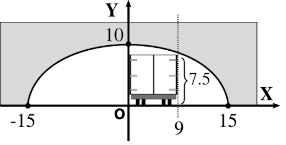
A semi-elliptical archway over a two-way road measures 10 feet in height and 30 feet in width.
A truck with a width of 9 feet and a height of 7.5 feet approaches the archway, driving on one side of the road.
Can the truck pass through the tunnel without striking the archway and without encroaching on the opposing lane of traffic?
-
The longest section of the Montreal Olympics Stadium is elliptical in shape. The major and minor axes of this ellipse measure 480 meters and 280 meters, respectively. Determine the standard equation of this ellipse.
This stadium was built for the 1976 Olympics. The leaning tower seen in the picture is 175 meters long and is the tallest of its kind.
This stadium was built for the 1976 Olympics. The leaning tower seen in the picture is 175 meters long and is the tallest of its kind.
-
Let \(S\) be the set of points \(P\) of the plane such that the distance from \(P\) to the point (2, 0) is a half the distance from \(P\) to the line \(x = 8\). Find an equation that satisfy all the points of \(S\). Identify this set.
-
Let \(S\) be the set of points \(P\) of the plane such that the distance from \(P\) to the point (0, 4) is \(\frac{4}{5}\) the distance between \(\frac{4}{5}\) and the line \(y = \frac{25}{4}\). Find equation that satisfy all points of S. Identify this set.
-
A satellite orbits the Moon in an elliptical path with the Moon’s center at one of the foci. The distances from the satellite to the Moon’s surface range from a maximum of 4,522 \(km\) to a minimum of 522 \(km\). Given that the Moon’s radius is 1,728 \(km\), determine:
-
the eccentricity of the orbit.
-
the standard equation of the orbit using the coordinate system with origin at the center of the orbit, and the center of the moon on the positive side of the X-axis.
-
Let \(P = (x_1, y_1)\) be a point of the ellipse \(\cfrac{x^2}{a^2}+ \cfrac{y^2}{b^2}=1\);
-
Prove that the slope of the tangent line to the ellipse at the point \(P = (x_1, y_1)\) is:
\[
m = -\frac{b^2x_1}{a^2y_1}
\]
First hint: The line \(T\): \(y = m(x -x_1) + y_1\) passes through \(P = (x_1, y_1)\).
Second hint: \(T\) is tangent to the ellipse if \(T\) intersects the ellipse in a unique point. Follow the steps of the solved problem 3.2.6.
Third hint: Wait until you learn derivatives.
-
Prove that an equation of the tangent line to an ellipse, \(T\), at the point \(P = (x_1, y_1)\), is the following:
\[
\cfrac{x_1 x}{a^2} + \cfrac{y_1 y}{b^2}=1
\]