In exercises 1 through 15, find the standard equation of the hyperbola satisfying the given conditions.
-
Foci: \((\pm 7, 0)\). Vertices: \((\pm 5, 0)\).
-
Foci: \((\pm 13, 0)\). Vertices: \((\pm 5, 0)\).
-
Foci: \((0, \pm6)\). Vertices: \((0, \pm2)\).
-
Foci: \((0, \pm 15)\). Vertices: \((0, \pm4)\).
-
Foci: (-2, 2), (8, 2). Vertices: (0, 2), (6, 2).
-
One focus: (-3, 3). Vertices: (-3, 0), (-3, -6 ).
-
Foci: (-1,2), (5, 2). One vertex: (4, 2).
-
Foci: \((\pm 3, 0)\). Asymptotes: \(y = \pm 2x\).
-
Foci: \((0,\, \pm\sqrt{58})\). Asymptotes: \(y = \pm \cfrac{5}{2}x\).
-
Asymptotes: \(x = \pm \sqrt{3}y\). Passes trough \((6, 4)\).
-
Foci: (2, 2), (6, 2), Asymptotes: \(y = x + 2\), \(y = -x + 6\).
-
Asymptotes: \(y = 2x + 1\), \(y = -2x + 3\). Passes trough (0, 0).
-
Vertices: (-5, 3), (1, 3). One asymptote: \(2y – x + 7 = 0\).
-
Vertices: (-1, 3), (3, 3). Eccentricity: \(e=\cfrac{3}{2}\).
-
Vertices: (-2, -2), (-2, 4). Latus rectum: \(L=2\).
In the exercises 16 through 19, completing squares, find:
-
the standard form of the hyperbola.
-
the vertices.
-
the foci.
-
the asymptotes.
-
\[
9x^2 – 16y^2 -54x + 64y – 127 = 0
\]
\[
\begin{aligned}
9x^2 – 16y^2 -54x &+ 64y
\\[1em]
&- 127 = 0
\end{aligned}
\]
-
\[
4x^2 – 9y^2 + 32x + 36y + 64 = 0
\]
-
\[
16x^2 – y^2 – 32x – 6y- 57 = 0
\]
-
\[
4x^2 – 9y^2 – 16x + 54y – 101 = 0
\]
\[
\begin{aligned}
4x^2 – 9y^2 – 16x &+ 54y
\\[1em]
&- 101 = 0
\end{aligned}
\]
-
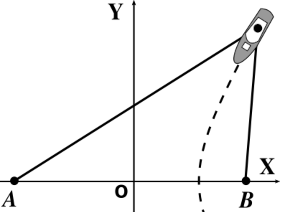
Two stations \(A\) and \(B\) of a LORAN system are 200 \(km\) away on a straight coast. Station B is to the west, and station A is to the east.
One ship receives the signal from the station \(B\), 0.0004 seconds before the signal from the station \(A\). The speed of the signal is 300,000 \(km/sec\).
-
If the ship sails to the coast keeping a constant time difference, find the equation of the route.
-
At what point will the ship reach the coast?
-
If the dock is located between the two stations, 70 \(km\) away from the station \(B\), find the time difference the ship must keep.
-
Two observers are stationed at points \(F_1=(-200, 0)\) and \(F_2=(200, 0)\) on the XY plane. An explosion occurs at a certain point on the XY plane and is heard by the observer at \(F_2\) one second before it is heard by the observer at \(F_1\). Determine the equation of the hyperbola where the explosion occurred.
-
Find the equation of the set of points \(P\) in the plane such that the distance from \(P\) to the point (−2, 1) is \(\frac{2}{\sqrt{3}}\) times the distance from \(P\) to the line \(x = -\frac{3}{2}\).
-
Let \(P=(x_1, y_1)\) be a point of the hyperbola \(\cfrac{x^2}{a^2}-\cfrac{y^2}{b^2}=1\).
-
Prove that the slope of the tangent line to the hyperbola at the point \(P = (x_1, y_1)\) is:
\[
m=\frac{b^2 x_1}{a^2 y_1}
\]
Hint: The line \(T\): \(y = m(x-x_1) + y_1\) pass through \(P = (x_1, y_1)\). \(T\) is tangent to the hyperbola if they intercept at a single point. Follow the same steps given in the solved problem 3.2.6.
Another Hint: Wait until you learn derivatives.
-
Prove that the a equation of the tangent line \(T\) to the hyperbola at the point \(P=(x_1, y_1)\) is:
\[
\cfrac{x_1 x}{a^2}-\cfrac{y_1 y}{b^2}=1
\]