-
If \(f(x)=\frac{x}{x+1}\), find:
-
\[
f(3)
\]
-
\[
f \left( 1+\sqrt{x} \right)
\]
-
\[
f(2+h) – f(2)
\]
-
\[
f(a+h) – f(a)
\]
-
if \( g(x) = x + \frac{(x-2)^2}{4}
\) find:
-
\[
g(2)
\]
-
\[
g(a+2)
\]
-
\[
g(a+h)-g(a)
\]
In exercises 3 through 8, find the domain and range of the given function.
-
\[
f(x) = \sqrt{x-9}
\]
-
\[
g(x) = \frac{ \sqrt{16-x^2} }{3}
\]
-
\[
h(x) = \frac{ \sqrt{x^2-4} }{2}
\]
-
\[
u(x) = \sqrt[3]{x-2}
\]
-
\[
f(x) = \frac{x^2-4}{x}
\]
-
\[
y = \sqrt{ x(x-2) }
\]
In exercises 9 through 14, find the domain of the function.
-
\[
g(x) = \frac{6}{ \sqrt{9-x} -2 }
\]
-
\[
y = \frac{1}{ \sqrt{x^2-4}-2 }
\]
-
\[
y = \sqrt{ 4 – \frac{1}{x} }
\]
-
\[
y = \frac{1}{4-\sqrt{1-x}}
\]
-
\[
y = \sqrt{ \frac{x+1}{2-x} }
\]
-
\[
y = \sqrt[4]{ \frac{x+5}{x-3} }
\]
In the exercises 15 and 16, find the domain, range and graph the function.
-
\[
g(x) = \begin{cases}
\left| x \right|, \; \text{ si } \; \left| x \right| \leq 1
\\[.5em]
\hspace{0.9em} 1, \; \text{ si } \; \left| x \right| > 1
\end{cases}
\]
-
\[
f(x) = \begin{cases}
\hspace{1em} \sqrt{-x}, \; \text{ si } \; x 2
\end{cases}
\]
-
Prove that:
-
If the graph of \(f\) is symmetric respect to the Y-axis, then \(f\) is even.
-
If the graph of \(f\) is symmetric respect to the origin, then \(f\) is odd.
-
If \(f(x+1) = (x-3)^2\) find \(f(x-1)\).
-
Find the quadratic function:
\[
f(x)= ax^2 + bx
\quad
\text{such that}
\quad
f(x)-f(x-1)=x,\;
\forall
x \in \mathbb{R}
\]
\[
\begin{aligned}
&f(x)= ax^2 + bx \quad \text{such that}
\\[1em]
&f(x)-f(x-1)=x,\;
\forall
x \in \mathbb{R}
\end{aligned}
\]
-
A hotel with 40 rooms observes a full occupancy rate when the room price is set at $30. However, for every $5 increase in rent, one room remains vacant. Given that the maintenance cost for an occupied room is $4, express the hotel’s profit as a function of the number of occupied rooms, denoted by \(x\).
-
When the daily production of a certain article does not exceed 1,000 units, the profit is 4,000 dollars per unit. If the number of articles produced exceeds 1,000, the profit decreases by 10 dollars for each article exceeding 1,000 units. Express the daily profit as a function of the number \(x\) of articles produced.
-
A farm is planting orange trees. If 80 trees are planted per hectare, each tree yields an average of 960 oranges. For every additional tree planted, the production decreases by an average of 10 oranges per tree. Express the total production \(p(x)\) of oranges per hectare as a function of the number of orange trees per hectare \(x\).
-
For mailing a box, regulations require a square base, with the sum of its dimensions (length + width + height) not exceeding 150 \(cm\). Express the volume of the box, given the maximum sum of its dimensions, as a function of \(x\), the length of the base side.
-
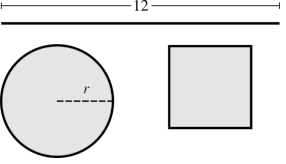
A 12-meter wire is cut into two pieces. One piece is used to form a circle, and the other to form a square. Express the total area enclosed by both figures as a function of \(r\), the radius of the circle.
-
The perimeter of an isosceles triangle is 36 \(cm\). Express the area of the triangle as a function of the length \(x\) of one of the two equal sides.
-
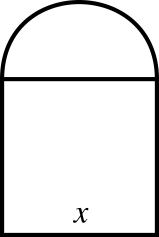
A window is shaped like a rectangle topped by a semicircle. The perimeter of this window is 7 meters. Express the area of the window as a function of the rectangle’s width, denoted as \(x\).
-
A factory needs to construct open-top boxes from metal sheets measuring 80 \(cm\) by 50 \(cm\). Equal squares will be cut from each corner, and the sides will then be folded upward, as illustrated in the figure. If \(x\) represents the side length of these small squares, express the box’s volume as a function of \(x\).
-
A book is to be published. Each page must have top and bottom margins of 3 \(cm\), and side margins of 2 \(cm\). The written area of each page must be 252 \(cm^2\). Express this area as a function of \(x\), the width of the written part of the page.