-
Without using a calculator, find:
-
\[
\cot \frac{5\pi}{3}
\]
-
\[
\sin \frac{7\pi}{6}
\]
-
\[
\tan \left( -\frac{\pi}{3} \right)
\]
-
\[
\sec \left( -\frac{7\pi}{6} \right)
\]
-
\[
\text{cosec} \left( -\frac{241 \pi}{6} \right)
\]
-
Find all \(\alpha \in \mathbb{R}\) such that:
-
\[
\tan \alpha
=0
\]
-
\[
\cot \alpha
=0
\]
-
\[
\sec \alpha
=0
\]
-
\[
\text{cosec } \alpha
=0
\]
-
\[
\text{sen } \alpha
=
-\frac{\sqrt{3}}{2}
\]
-
Prove that:
-
\[
\cot(\alpha + \pi)
=
\cot \alpha
\]
-
\[
\sec(\alpha+\pi)
=
-\sec \alpha
\]
-
\[
\text{cosec}(\alpha + \pi)
=
-\text{cosec} \alpha
\]
-
Prove that:
-
\[
\cos(n \pi)
=
(-1)^n
\]
-
\[
\cos(\alpha + n\pi)
=
(-1)^n \cos \alpha
\]
-
\[
\sin(\alpha + n \pi)
=
(-1)^n \sin \alpha
\]
-
Let \(P=(x, y)\neq(0, 0)\) be a point of the plane with a distance of \(r\) from the origin. If \(L(t)\) is the point of intersection between the segment \(\overline{\text{O}P}\) and the unit circle, prove that:
-
\[
\sin t = \frac{y}{r}
\]
-
\[
\cos t = \frac{x}{r}
\]
-
\[
\tan t = \frac{y}{x},\; x \neq 0
\]
-
Find the value of \(\sin (-{23\pi/2}) \cos(31 \pi)\).
-
If \(\alpha + \beta + \gamma=\pi\), simplify:
-
\[
\sin( 2\alpha + \beta + \gamma )
\]
-
\[
\sin( 2\alpha + \beta + \gamma ) + \sin(\beta + \gamma)
\]
-
We know that the period of \(y=\sin x\) is 2π, and the period of \(y=\cot x\) is π. With that in mind, find the period of the following functions:
-
\(f(x) = \sin(\gamma x)\), where \(\gamma > 0\).
-
\(g(x) = \cot(2x)\)
-
A circle has a radius of 18 \(cm\). Find the measure, in radians, of a central angle with an arc length of:
-
\[
6 \; cm
\]
-
\[
1.8\; cm
\]
-
\[
6 \pi \; cm
\]
-
Find the length of the arc subtended, on a 9 \(cm\). radius circle, by a central angle of:
-
\(\frac{\pi}{6}\) radians.
-
\(\frac{5}{4} \pi\) radians.
-
\(50^{\circ}\).
-
The distance between two points, \(A\) and \(B\), on the Earth’s surface is defined as the length of the arc formed by these points and the Earth’s center, C. Since the radius of the Earth is 6.367 \(km\), find the distance between \(A\) and \(B\) if the angle ∠ACB measures:
-
\[
1^{\circ}.
\]
-
\[
30^{\circ}.
\]
-
\[
45^{\circ}.
\]
-
\[
80^{\circ} 45′.
\]
-
In the above problem, if the angle ∠ACB measures 1′ (one minute), then the distance between \(A\) and \(B\) is a nautical mile. How many kilometers does a nautical mile have?
-
How many radians does the minute hand of a clock turn in a time span of 20 minutes?
-
Find the measure in degrees of the angle that is supplementary to an angle of \(\frac{\pi + 1}{2}\) radians.
-
Two angles of a triangle measure \(\frac{\pi + 1}{2}\) and \(\frac{3\pi – 4}{8}\) radians, respectively. Find the measure in degrees of the remaining angle.
-
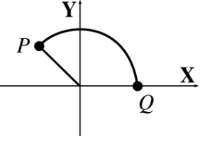
In the figure, the arc \(\stackrel{\frown}{QP}\) has a length of \(\frac{7\pi}{3} \, cm\). Find the point \(P\).
-
In the figure, the radius of the circle is 3 \(cm\) and the length of the arc \(\stackrel{\frown}{QP}\) is 2π. Find the point \(P\).
-
The terminal side of an oriented angle in standard position is the segment \(\overline{OP}\), where O is the origin, and \(P=(-2, 6)\). If the measure of this angle is α radians, find the value of: \((\sin \alpha – 3\cos \alpha)(\tan \alpha)(\sec \alpha)\).
-
Find the value of:
-
\[
\frac{ \sin(-750^{\circ}) }{ \cos(-150^{\circ}) }
\]
-
\[
\frac{ \cos(-1,290^{\circ}) }{ \tan(7,515^{\circ}) }
\]
-
Find the value of:
\[
\left( \cos \frac{11 \pi}{6} + \sin \frac{26 \pi}{4} \right) \left(
\tan \frac{\pi}{6} + \cos \frac{14\pi}{3} \right)
\]
\[
\begin{aligned}
&\left( \cos \frac{11 \pi}{6} + \sin \frac{26 \pi}{4} \right)
\\[1em]
&\hspace{3em} \times
\left(
\tan \frac{\pi}{6} + \cos \frac{14\pi}{3} \right)
\end{aligned}
\]
\[
\]
-
Find the length of the side of a regular polygon of \(n\) sides inscribed in a circle of radius \(r\).
-
The tires of a car have a diameter of 60 \(cm\). How many revolutions per minute does each tire spin when the car runs at 90 \(km\) per hour?
-
Two gears are linked by a belt, as the figure shows. The radii of the gears are 14 \(cm\) and 8 \(cm\), respectively. How many revolutions per second does the small gear spin when the big gear spins 28 revolutions per second?
-
An isosceles triangle is inscribed in a circle of radius 5 \(cm\). Find a function that expresses the perimeter \(P\) of the triangle in terms of the angle θ.
-
To construct a conic cup, a circular sector is cut from a circular plate with a 10 \(cm\) radius. Determine a function that expresses the cup’s volume in terms of its central angle θ.
The volume of a cone is: \(V =\frac{1}{3}\pi r^2h\)
-
A line has an inclination angle of \(\frac{\pi}{4}\) radians and does not intersect the second quadrant. If the distance between the origin and the line is 4, determine the equation of the line.
-
Find the acute angle between the lines:
\[
3x + 2y=0
\quad
\text{ and }
\quad
5x-y + 7= 0
\]
-
Find the equation of the line passing through the point \(Q=(2, 1)\) that generates an angle of \(\pi /4\) radians with the line \(3y + 2x + 4 = 0\) (two solutions).
-
The points (6, 2) and (-1, 3) are opposite vertices of a square. Determine the equations of the lines that form the sides of this square.